Ikaria Island
Cartes Postales from GreeceIkaria Island moves from a distant image on Ellie Thomas’s pinboard to a place the traveling narrator chooses to explore for himself. Its landscapes and reputation resist the easy promises of a postcard: the island is rugged and remote, yet the narrator finds extraordinary peace there, meets active residents in their eighties and nineties, and encounters Ariadne, whose storytelling makes the past feel vividly present.
From Postcard to Destination
Before the narrator reaches the island, Ikaria appears in the chain of Greek places depicted on the postcards Ellie Thomas collects. Their blue-and-white images gradually become part of her everyday life, and she falls in love with a country she has never visited. When the cards stop arriving, the last one she remembers from Ikaria sharpens the question of whether their luminous skies reflect reality or exaggeration. Her decision to travel to Greece is spontaneous, but the postcards have been preparing it for months.
The narrator’s own visit comes after time spent on Andros Island. He spends a final night there with Angeliki, then sets out for Ikaria Island by way of the more touristic Mykonos, which he does not want to visit, and the port at Evdilos. His route echoes the book’s movement from imagined destinations to lived encounters: the island is not simply a picture to be collected, but a place whose character has to be approached on its own terms.
Reputation and Isolation
Before arrival, the narrator hears a long catalogue of reasons to avoid Ikaria. It is described as windy, with stormy seas, rocky ground, ravines, and bare mountains. Stories of the past add to the impression of hardship: pirates repeatedly attacked the island, and men once went away to sea for years, leaving women to manage without their protection. In the twentieth century, Ikaria became an open prison for political exiles. The narrator also hears it dismissed as a backwater, supposedly inhabited mainly by old people, while the young leave in search of a better life. He is told that the Greek government neglected the island for years.
Advice about what the island is worth visiting for proves no more reliable. A man in Tripoli recommends only the supposed birthplace of Dionysus and the strong red Pramnios wine, while calling the island politically left-wing. The narrator notes that this speaker is reading the far-right newspaper Golden Dawn and drinking ouzo with his morning coffee, and decides not to trust his travel judgment. The anecdote presents the island’s reputation as something made and repeated by outsiders, not a settled account of what a visitor will find.
Landscape and Longevity
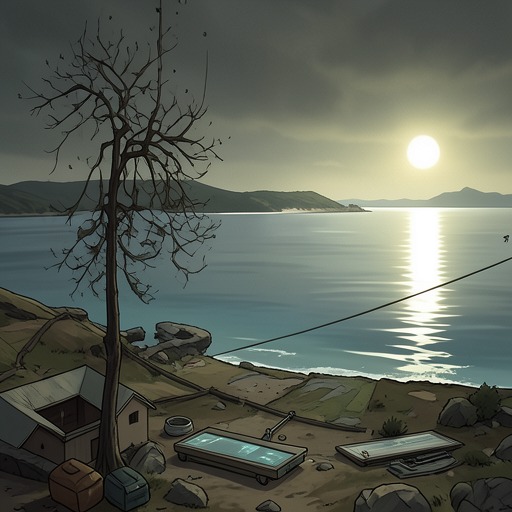
The narrator’s first afternoon confirms his decision to come. He hardly sees another car, and the dramatic, rocky terrain gives way to a broad stretch of smooth white rock sloping toward the sea. He sits there for several hours with the sun on his back. The light seems to saturate everything; the sea and sky are luminously blue, and he feels an unusual peace, as though time has stood still for a thousand years. The stillness is not merely a picturesque view: it changes the pace of his journey and makes him feel he will not be in a hurry to leave.
The island’s human landscape also challenges the idea that it is simply a place where the young have gone and only the old remain. The narrator is curious about Ikaria’s exceptional life expectancy, which is much higher than the European average and has drawn scientists to study the phenomenon. He meets energetic octogenarians and nonagenarians running shops, cafés, and small hotels, fishing, or mending boats. Their silver-white hair and apparent physical vigor make them seem far younger than they are.
No single explanation is established. Some people attribute longevity to an unhurried, low-stress way of life: residents rise late, open their shops at their own pace, and do what they want when they want. Others point to radium-rich hot springs that flow into the sea. The narrator reports the local claim that one in three people lives into their nineties, while leaving the cause unresolved. The island’s longevity thus remains both a measurable curiosity and an open question about how its people live.
Ariadne and the Island’s Stories
The narrator’s most extraordinary encounter is with Ariadne, a resident of Agios Kirykos who calls herself the oldest person on the island. Opinions about her differ: some people consider her a fantasist, while others call her mad. Yet nobody can disprove her claim to be the oldest, because nobody can establish that anyone is older. The narrator describes her strong silver hair and pale, smooth skin, which make her age impossible to guess. She is also a familiar curiosity for tourists, usually found at a seafront café advertising her Icarus Tours.
The narrator joins one of Ariadne’s guided walks. The group of ten gathers on the quayside at Agios Kirykos beneath a large modern sculpture of a pair of wings. Ariadne gestures south and announces that she will tell them about two birds from Crete. She tells the story in the present tense, a technique associated in the passage with historians bringing events to life, and quickly holds her audience’s attention. Listening, the narrator becomes ready to believe not only that Ariadne is the island’s oldest resident but that she was born thousands of years ago.
Ikaria Island’s narrative significance lies in the interplay between what can be established and what is carried by stories. Its rough terrain, political history, long-lived inhabitants, and springs belong to the island the traveler encounters; Ariadne’s performance gives that setting a mythic dimension without erasing its present-day life. The modern wings above the quayside make the connection visible: the island’s landscape and the story told there meet in a place where the narrator finds that a storyteller can leave as lasting an impression as the story itself.